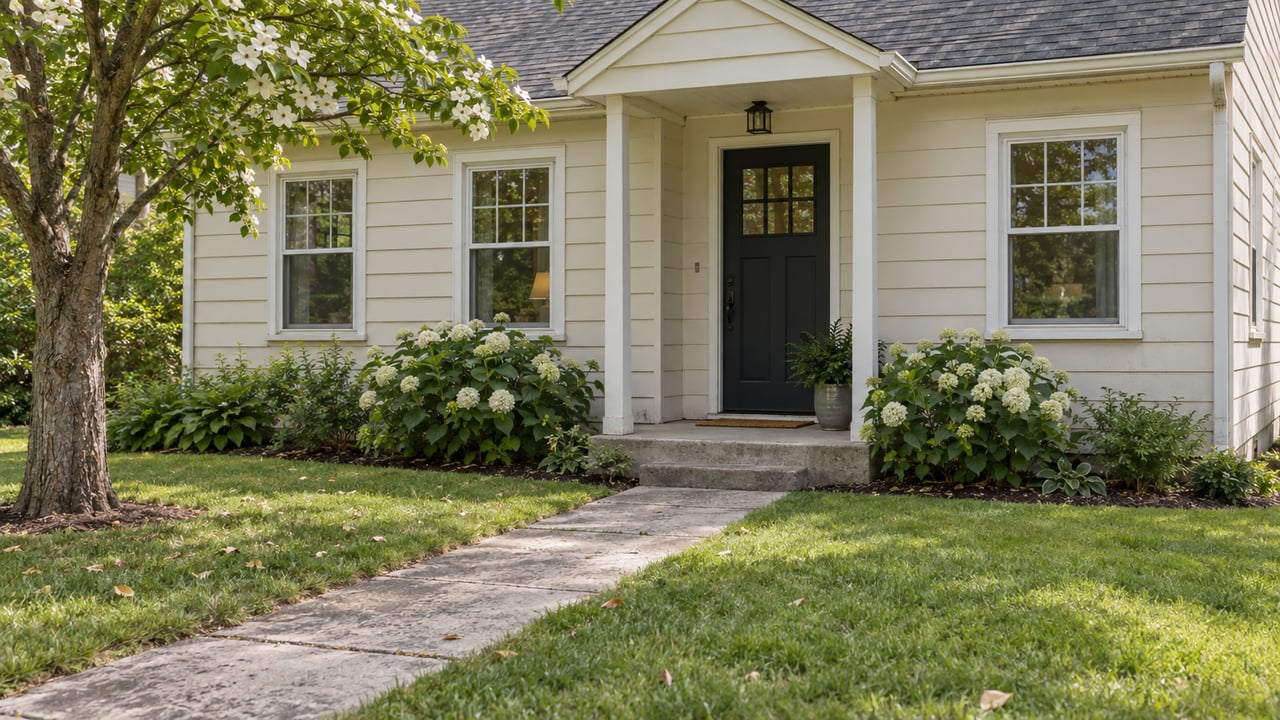
A buyer's agent pulling land records on a modest rambler in Aurora Highlands or Alcova Heights this year might run into something that doesn't show up on a standard property disclosure: a notice, recorded against the property itself, which the lawsuit's GoFundMe page describes as telling any future purchaser that a pending lawsuit could void the zoning rights attached to the lot and eliminate the right to build what's already been permitted there It isn't boilerplate. It's a direct consequence of a Virginia Supreme Court case that, as of this writing, still hasn't been scheduled for a hearing.
That case is Nordgren v. Arlington County Board, and it's the reason a small but growing slice of Arlington's smallest residential lots are worth a genuinely different amount of money depending on which way a judge rules.
Why the notice exists
Arlington's Expanded Housing Options ordinance, commonly called Missing Middle, passed the County Board unanimously in March 2023. It allows by-right construction of up to six units on lots that had previously been zoned for one single-family home only, covering land that made up more than 70 percent of the county's residential parcels. A group of homeowners sued almost immediately, arguing the county hadn't properly studied the impact on stormwater systems, tree canopy, and neighborhood infrastructure before adopting it.
In September 2024, The Washington Post reported that retired Fairfax County judge David Schell agreed with them and struck the ordinance down entirely, voiding it from the date it was adopted. Forty-five permitted projects were paused overnight. Then, in June 2025, the Virginia Court of Appeals reversed that ruling, but not on the substance of the case, according to ARLnow. The appellate panel found that developers holding EHO permits should have been named as parties to the lawsuit and sent it back down. That procedural reversal put the ordinance back on the books, and it's the version of events currently in effect.
On May 19, 2026, the Virginia Supreme Court agreed to take up the plaintiffs' challenge to that procedural ruling. County spokesperson Erika Moore was careful to note the underlying merits of the case, whether EHO is actually valid, still aren't part of what the court agreed to review. Advocates funding the homeowners' litigation expect a trial on those merits within three to six months. In practice, that means the legal question that actually matters, whether Missing Middle survives at all, remains open going into 2027.
The same lot, two very different prices
The clearest way to see what this uncertainty is worth is to look at one property that's already been through it. A century-old house at 3802 14th Street North, an 11-minute walk from the Virginia Square Metro station, sold for $913,000 in 2022 and was assessed at $954,000 in 2024. Under EHO, it's being replaced by a six-plex, six separate homes on a lot that used to hold one.
A block away, a comparable teardown candidate built in 2011 sold in 2024 for $1.8 million as a single replacement house. Arlington-wide, a new single-family home built after a teardown now averages around $2.4 million. A five-bedroom, three-and-a-half-bath duplex in North Highlands, one of the completed EHO projects already through construction, closed in March 2026 for $1,610,000.
| Path | What gets built | Recent sale evidence |
|---|---|---|
| Single-family teardown, rebuilt as one house | One larger home | Comparable teardown sold for $1.8M; countywide average near $2.4M |
| EHO redevelopment | Up to six smaller homes | North Highlands duplex closed for $1.61M in March 2026 |
| Original small lot, unbuilt | One older, smaller house | 3802 14th St N sold for $913K in 2022, assessed $954K in 2024 |
The county's own one-year report on EHO permits (covering July 2023 through June 2024) found the average EHO home comes in at 1,646 square feet with three bedrooms, while the 80 single-family detached permits issued in that same window averaged 5,259 square feet with five bedrooms. Same zoning districts, same underlying dirt in many cases, two entirely different products and two entirely different price points depending on which legal outcome the lot ends up under.
That gap is the actual mechanism at work here. It isn't that Arlington real estate is broadly uncertain. It's that a specific category of small lot, in R-5 and R-6 zoning, is currently worth a range rather than a number, and the range is wide enough to change a listing price by hundreds of thousands of dollars depending on how the Supreme Court rules.
Why builders are asking for "vested rights" instead of waiting
Because the legal status of EHO has flipped twice in eighteen months, builders holding permits have started petitioning Arlington Circuit Court directly for what's known as vested rights, according to Neighbors for Neighborhoods It's a workaround born entirely out of the appeals whiplash.
The land record notice tied to some of the 45 originally permitted projects spells out the stakes plainly for anyone buying in: a pending appeal could still void the zoning rights attached to that specific property.
What to actually check before writing an offer
For a buyer or seller weighing one of these Arlington lots against a comparable property in a neighborhood without EHO exposure, the practical checklist looks different from a standard purchase:
- Confirm the zoning district. According to Patch, R-5 lots (roughly 5,000 square feet) and R-6 lots (roughly 6,000 square feet) absorbed the large majority of EHO permits issued so far and remain the primary battleground.
- Check Arlington County's EHO permit tracker for the specific address, which shows whether a permit has been approved, is under Board of Zoning Appeals challenge, or was withdrawn.
- Search land records for any notice tied to the property referencing the pending litigation.
- Ask whether the builder has separately petitioned Arlington Circuit Court for vested rights.
- Check for a private deed covenant restricting construction to single-family homes. Courts have consistently upheld these.
What this isn't
This uncertainty doesn't touch most of Arlington's housing stock day to day. The case's effect on any particular property depends on its zoning and permit history.
A few common questions
Does this affect a condo or townhome I'm already looking at? Check the property's zoning and permit history before drawing conclusions.
What's the practical difference between R-5 and R-6? Both are among Arlington's smallest residential zoning districts and together they've received the bulk of the county's EHO permits so far, R-6 in particular.
When will this actually get resolved? The Virginia Supreme Court hasn't set a hearing date as of this writing, and even a ruling in that appeal would only resolve the procedural question, sending the substantive case back to trial court either way. A final answer on whether EHO survives is realistically still a matter of months, not weeks.
If you're comparing a small Arlington lot against something in Falls Church or McLean and the zoning history matters to your offer strategy, that's exactly the kind of transaction detail worth walking through before you write anything up. I pull the permit history, check the land records, and work with title to make sure you know what you're actually buying. Anthony C Ford - Contact Anthony Anytime.
This article is general information, not legal, tax or financial advice. Consult a qualified professional about your situation.